

Key takeaways
- Price the budget from a signed process scope, not from a list of app names.
- Treat Odoo licences and hosting as recurring costs paid to Odoo or your host, separate from the implementation fee.
- Count the hours your finance and operations staff will spend on data cleaning, testing and training.
- Every custom module adds a cost at each future version upgrade, so keep custom work to what earns its place.
- Include a support plan and one version upgrade in the first three years of the budget.
Part of our guide: Odoo implementation guide: how to implement Odoo ERP from scoping to go-live
What goes into an Odoo implementation budget?
An Odoo implementation budget is the full cost of getting Odoo live and keeping it useful for its first few years, not just the fee for the setup project. It has one-off lines, such as configuration and data migration, and recurring lines, such as licences, hosting and support. Mixing the two is the most common reason a budget looks fine in the first quarter and wrong by the end of the year.
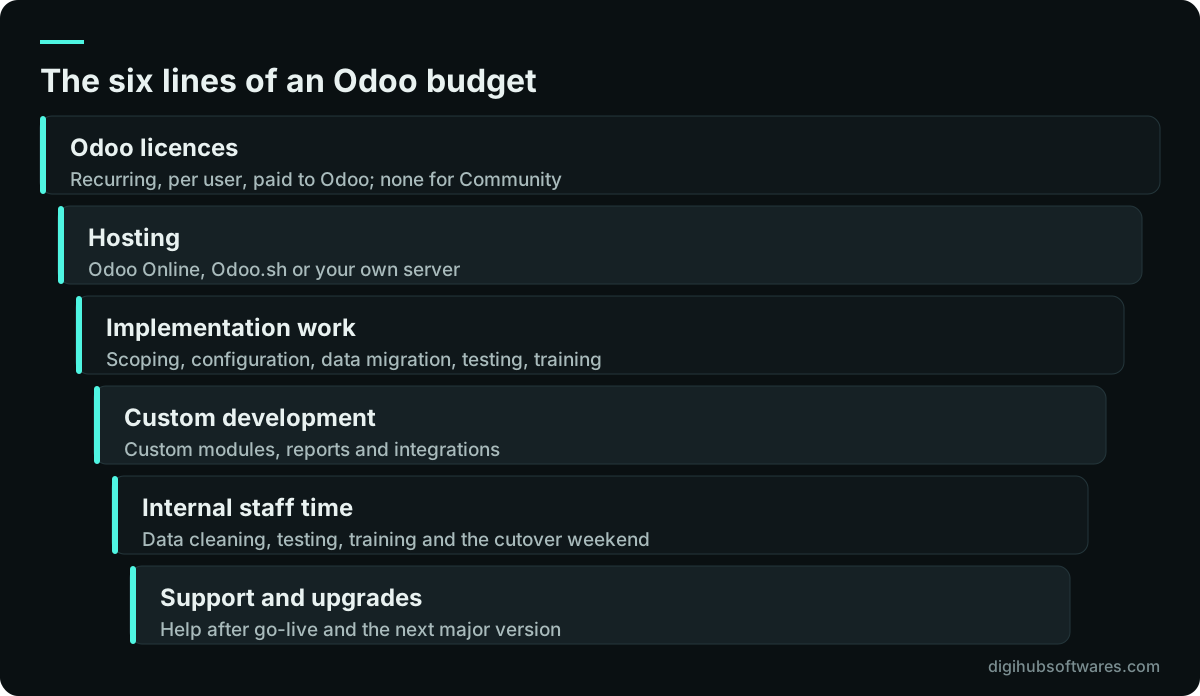
The six lines in the diagram below cover almost every Odoo project. The order matters: the lines at the top are set by Odoo and your hosting choice, while the lines lower down are set by your scope and your own team. Our complete Odoo implementation guide explains the phases those costs pay for.
How much do Odoo licences cost?
Odoo Enterprise is sold as a subscription priced per user per month, and Odoo Community has no licence fee at all. Odoo's prices vary by country and change from time to time, so take the current figure from the Odoo pricing page (opens in a new tab) on the day you build the budget rather than from an old quote.
At the time of writing, Odoo lists three plans: One App Free, which gives one app with unlimited users on Odoo Online; Standard, which gives all apps on Odoo Online; and Custom, which adds Odoo.sh or on-premise hosting, Studio, multi-company and external API access. That last point is easy to miss. A group with two legal entities, or a project that needs Studio or an integration through the API, belongs on the Custom plan, and the licence line has to reflect that.
Community saves the licence fee but not every cost. It needs self-hosting, it lacks full Accounting, Studio, the mobile apps and several service apps, and it has no Odoo upgrade service. Before choosing it to save money, read what you actually lose with Odoo Community and price the work needed to fill the gaps.
What does hosting add to the cost?
Hosting is included in the Odoo Online plans, priced separately on Odoo.sh, and paid to a cloud provider when you self-host. Odoo Online is the cheapest route to run, but it accepts no custom modules, so it only suits projects that stay within standard apps and Studio.
Odoo.sh is priced by components: workers, storage, the hosting type and optional staging environments, and Odoo states on its Odoo.sh pricing page (opens in a new tab) that the hosting price does not include the Enterprise licence. Self-hosting adds a server bill plus the time to patch, back up and monitor it, which someone has to do every month.
Our comparison of Odoo Online, Odoo.sh and self-hosting sets out which route fits which kind of company. For the budget, the rule is simple: decide hosting before you price custom work, because the hosting choice decides whether custom work is possible at all.
What drives the implementation cost?
The implementation fee is driven by scope: how many apps, companies and users, how far your processes depart from standard Odoo, and how much data has to be cleaned and moved. Two companies with the same app list can have very different budgets because one runs standard flows and the other has years of exceptions built into its old system.
These are the drivers to measure before asking for a quote.
- Number of apps in the first phase, and how deeply each one is used.
- Number of companies, currencies and warehouses sharing the database.
- Number of users and distinct roles that need their own access rules and training.
- Process steps that need configuration beyond the defaults, such as multi-step approvals or routes.
- Custom modules, custom reports and changes to invoice or delivery layouts.
- Integrations with banks, payment gateways, marketplaces, couriers, payroll or legacy software.
- Data volume, years of history and the state of the source data.
- Tax localization work, such as UK VAT under Making Tax Digital, UAE VAT and Corporate Tax, or Pakistan FBR sales tax.
- Training format, number of sessions and whether written guides are needed per role.
What are the hidden costs of an Odoo project?
The hidden costs of an Odoo project are mostly your own people's time. Someone in finance has to approve the chart of accounts and reconcile the migrated balances. Someone in the warehouse has to count stock before the cutover. Every process owner has to write test scenarios and sign them off. None of this appears on an implementer's invoice, but it competes with the day job.
Plan for it explicitly. Name a project owner who can make decisions within a day, and agree how much of each key user's week goes to the project during design and testing. If the project runs alongside a year end or a busy season, either move the dates or budget for temporary cover.
The other hidden cost is delay. Slow decisions stretch a project, and a longer project costs more in fees, in parallel running of two systems and in staff fatigue. A budget that assumes quick answers from the business should say so, so that everyone knows what slows it down.
What should you budget after go-live?
After go-live, budget for regular support, ongoing small changes and at least one major version upgrade within the first three years. Odoo gives each major version three years of standard support, so a database that goes live on Odoo 20 in late 2026 will need an upgrade plan before standard support ends, planned for September 2029.
Upgrades cost more when there is more custom code, because every custom module has to be ported and tested on the new version. Our guide to planning an Odoo version upgrade explains how to estimate that work. For support, Digihub publishes prepaid options on its Odoo pricing page: a 10-hour block at $330 (£250 or AED 1,200) and a 40-hour block at $1,200 (£920 or AED 4,400), each valid for 3 months, or Monthly care at $650 a month (£495 or AED 2,400) with 20 hours of support. Extra hours are $35 each.
| Add-on | Price | Unit |
|---|---|---|
| Version upgrade, standard database | From $1,500 / £1,150 / AED 5,500 | Per project |
| Tax localization setup (UK MTD VAT, UAE VAT and Corporate Tax, or Pakistan FBR) | From $590 / £450 / AED 2,000 | Per project |
| Custom module | From $900 / £690 / AED 3,300 | Each |
| Extra hour | $35 / £27 / AED 130 | Per hour |
How do you build an Odoo implementation budget step by step?
Build an Odoo implementation budget in five steps, starting from the scope and ending with a three-year view. This order stops the common mistake of fixing a number first and squeezing the scope to fit it later.
- 1. Write the scope: apps, companies, users, processes, data and integrations, each process step marked standard, configured or custom.
- 2. Choose edition and hosting, then price licences and hosting for year one from the vendors' own pricing pages.
- 3. Get a fixed quote for the implementation work against the written scope, with custom modules and integrations priced as separate items.
- 4. Estimate internal staff time by role and phase, and add any temporary cover you need.
- 5. Add support, a contingency for scope found during design, and one major upgrade, then show the total over three years.
What do Digihub's fixed Odoo packages cost?
Digihub publishes three fixed implementation packages, quoted exactly here from our Odoo pricing page. They cover the implementation work only. Odoo licences are billed by Odoo, hosting is paid to the provider, and prices exclude VAT or sales tax. PKR prices are a separate local price list, not a conversion.
Starter is $2,400 (£1,850, AED 8,900 or PKR 390,000) for 1 to 3 apps and up to 15 users, over 3 to 5 weeks, with 30 days of support after go-live. Growth is $6,500 (£4,950, AED 23,900 or PKR 950,000) for 5 to 8 apps with multi-company, over 6 to 10 weeks, with 60 days of support. Enterprise starts from $13,500 (£9,950, AED 49,500 or PKR 2,000,000) for 9 or more apps, custom modules, integrations and data migration, over 10 to 16 weeks, with 90 days of support. The final Enterprise price is fixed after a short discovery.
If you are unsure which package matches your scope, our Odoo consulting work starts with exactly that question, and our Odoo implementation service page shows what each phase delivers.
How can you reduce the cost without cutting corners?
The safest way to reduce cost is to shrink the first phase, not to thin out testing or training. Go live with the apps that carry the money, such as Sales, Purchase, Inventory and Accounting, and add the rest once those are stable.
Other savings that hold up: accept standard Odoo flows wherever the old process was a workaround; clean your own master data before the project starts; migrate open items and balances instead of years of history; and replace custom code with configuration or Studio where the result is close enough. Each of these lowers both the project fee and the cost of every future upgrade.
Sources and further reading
Official documentation and guidance if you want to read more about this topic.
Related guides and services
Questions readers ask
How much does Odoo implementation cost for a small business?
For a small business using a few standard apps, the implementation work is usually the smallest part of a multi-year budget, with licences and support recurring every year. Digihub's Starter package is $2,400 (£1,850 or AED 8,900) for 1 to 3 apps and up to 15 users, excluding Odoo licences and hosting. Add licences from Odoo's pricing page and your own staff time.
Are Odoo licences part of the implementation fee?
No. Odoo Enterprise licences are a subscription billed by Odoo directly to your company, priced per user per month and varying by country. The implementation fee pays for the setup work only: scoping, configuration, data migration, testing and training. Keep the two as separate lines in your budget, because licences recur every year while most of the implementation fee is paid once.
Is Odoo Community really free?
Odoo Community has no licence fee, but it is not free to run. You pay for hosting and server care, and you may pay to build or buy what Community lacks, such as full accounting features, Studio-style changes or a mobile experience. Community also has no Odoo upgrade service. For some companies those costs are lower than Enterprise licences; for others they are higher.
What is the biggest hidden cost in an Odoo budget?
The biggest hidden cost is your own staff's time. Finance, operations and sales leads spend hours approving designs, cleaning data, writing test scenarios and attending training, all while doing their normal work. Delay is the second hidden cost, since slow decisions stretch the project. Budget named hours per key user and plan the project around busy seasons and year ends.
How often will I pay for an Odoo upgrade?
Plan for a major version upgrade at least once every three years, since Odoo gives each major version three years of standard support. Odoo Online upgrades on Odoo's schedule, while Odoo.sh and self-hosted databases allow more choice of timing. The cost depends mostly on custom code. Digihub's version upgrade for a standard database starts from $1,500 (£1,150 or AED 5,500).