

Key takeaways
- Start every service page with a two-sentence definition: what the service is, who it suits and where you provide it.
- Write each heading as a buyer's question and answer it in the first sentence underneath.
- Replace vague claims with checkable specifics: steps, deliverables, timelines, cost drivers and limits.
- Put comparisons in real HTML tables and processes in numbered lists, which both people and AI systems lift accurately.
- Allow OAI-SearchBot and PerplexityBot in robots.txt if you want to be cited in ChatGPT search and Perplexity.
Part of our guide: Technical SEO checklist for service businesses
What changes when you write service pages for AI search?
Less than many people claim. Google's page on AI features and your website (opens in a new tab) states that there are no additional requirements or special optimizations needed to appear in AI Overviews or AI Mode: the page must be indexed and eligible to show a snippet, and standard SEO best practices apply. Terms such as answer engine optimization (AEO) and generative engine optimization (GEO) describe the same discipline with more attention to being quoted.
What does change is how a page gets used. An AI answer lifts a sentence, a list or a table from your page and places it next to text from other sites. If the page opens with three paragraphs of welcome copy, there is nothing worth lifting. If it opens with a precise definition and a clear answer to the buyer's question, it can be cited, and the buyer who clicks through arrives already half convinced.
So the aim when writing service pages for AI search is simple: make every section self-contained, specific and true, so it still makes sense when quoted on its own.
What should a service page contain, from top to bottom?
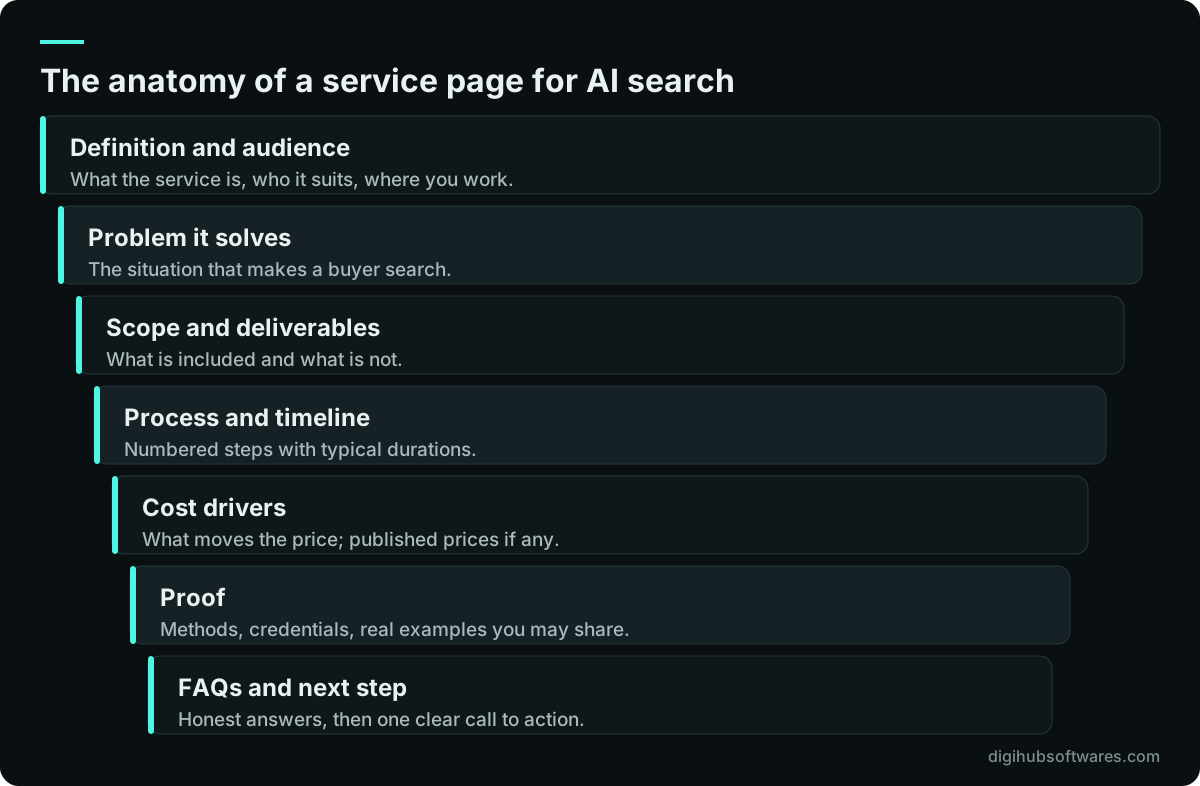
A service page that works for Google, AI answers and buyers follows a predictable order: a definition, the problem it solves, what is included, how the work runs, what it costs and why, proof, FAQs and a clear next step. Predictable is good here, because buyers scan for the same things on every vendor's page.
Keep one service per page and one primary query per page. A page that tries to cover website design, SEO and hosting at once gives neither Google nor an AI system a clear answer to quote. If two services share most of their content, merge them; if they serve different buyers, split them and link between them.
How do you write answer-first sections that get quoted?
Write each H2 as a question a buyer would type or ask aloud, then answer it fully in the first one or two sentences before adding detail. A reader who stops after the first line should still have the answer.
Compare two openings for a section headed What happens after the website launches? The weak version begins: We are with you every step of the way. The strong version begins: After launch you get 30 days of free fixes for anything that does not work as agreed, and after that support is available as an optional monthly plan. The second one can be quoted, checked and acted on. The rest of the section can then explain what each plan covers.
Use definitions in the form X is Y, numbered steps for processes, and short paragraphs that each make one point. Name products, standards and places precisely. Write numbers as numbers, and give the unit and the condition: within 30 days of go-live is useful; fast turnaround is not.
Why do specifics matter more than claims?
Specific, checkable statements are what make a page trustworthy to readers and worth citing for AI systems. Google's guidance on helpful, reliable, people-first content asks whether a page provides original information and demonstrates first-hand expertise. Phrases such as tailored solutions or experienced team appear on every competitor's page and tell nobody anything.
Replace them with what you actually do. Name the steps of your process and what the client receives at each one. State what is out of scope. Give the factors that drive cost and, if you publish prices, the real figures with a link to your pricing page. Say who should not hire you, for example businesses that need on-site staff every day. Honest limits make the rest of the page more believable.
Do not invent proof. Fabricated statistics, testimonials or client logos can mislead buyers and damage trust once discovered. If you cannot share client names, describe your method and the kind of problems you solve instead.
- Instead of fast delivery: a dated milestone for each stage in the proposal, from design sign-off to launch.
- Instead of transparent pricing: the price depends on page count, integrations and content writing; see published packages.
- Instead of ongoing support: 30 days of free fixes after launch, then optional monthly maintenance.
- Instead of expert team: the named lead, their role and the platforms they work with.
Do tables, FAQs and schema still help service pages?
Yes, but for clarity rather than special search features. Comparison tables written in real HTML, not as images, are easy for readers to scan and for AI systems to read correctly, for example options against criteria, or packages against what each includes.
FAQs are still worth writing because buyers ask the same questions before they call. Their rich result is a different matter: since 2023 Google shows FAQ rich results only for well-known government and health websites, so expect no expandable FAQ snippet. Answer each question in the first sentence, keep answers short and cover objections honestly, including price, timelines and who you are not a fit for.
Structured data helps Google understand the entity behind the page. Use Organization or LocalBusiness and BreadcrumbList, and you may describe the offering with the schema.org Service type, but Google has no rich result for it. Google's structured data general guidelines (opens in a new tab) require markup to describe content that is visible on the page, so never mark up reviews or FAQs that visitors cannot see.
Can AI search engines reach and read your service pages?
AI assistants can only cite pages their crawlers are allowed to fetch and can read without running scripts. Check both before rewriting any copy.
For Google, AI Overviews use the normal Googlebot crawl, so blocking Googlebot or adding nosnippet removes you from AI features too. The separate Google-Extended token controls use in Gemini apps and some Vertex AI grounding, and Google states it does not affect inclusion or ranking in Google Search. For ChatGPT, OpenAI's crawler documentation (opens in a new tab) explains that OAI-SearchBot surfaces sites in ChatGPT search, while GPTBot collects training data; blocking GPTBot does not remove you from ChatGPT search. Perplexity uses PerplexityBot for its search results.
Then check rendering. Many AI crawlers do not run JavaScript, so service content that only appears after scripts load may be invisible to them. Our technical SEO checklist for service businesses covers rendering, indexing and robots.txt in detail.
How do local service pages fit into AI answers?
For local queries, AI answers lean on the same local data Google uses for its map results, so your website and Google Business Profile must agree. Use the same business name, service names, areas and contact details on both.
Write location pages only where you have something different to say for that place: travel and on-site arrangements, local regulations, typical projects or a local contact. Thin pages that swap a city name are unlikely to be cited. Our Google Business Profile checklist covers the profile side, including categories and service areas.
How do you measure results, and when should you get help?
Measure service pages for AI search by enquiries first, like any other page. Search Console includes AI Overviews and AI Mode traffic within the normal Web search performance data, so watch impressions, clicks and the queries each service page receives. Referrals from chatgpt.com and perplexity.ai show up in GA4 as referral traffic. Ask new leads how they found you, because some will have read an AI answer and then searched your name.
Rewriting a handful of core service pages is often the highest-value content work a service business can do. Our on-page SEO services cover the structure, headings, internal links and schema, and our SEO content writing services produce the copy with your team's input. Landing page copy is listed at $99 per page on our digital marketing pricing page, and businesses in fields such as law, accounting and consulting can see how we approach professional services.
Sources and further reading
Official documentation and guidance if you want to read more about this topic.
Related guides and services
Questions readers ask
Do I need special optimization to appear in Google AI Overviews?
No. Google states there are no additional requirements to appear in AI Overviews or AI Mode beyond being indexed and eligible to show a snippet in Search. In practice, clear answer-first sections, accurate facts, crawlable HTML and a page that matches the search intent give a service page the best chance of being used as a supporting link.
Should I block AI crawlers from my website?
Block training crawlers if you object to your content training models, but allow the search crawlers if you want citations. OpenAI separates GPTBot for training from OAI-SearchBot for ChatGPT search, and Perplexity uses PerplexityBot for search results. Blocking Googlebot removes you from Google Search entirely, including AI Overviews, so do not block it.
What is the difference between AEO, GEO and SEO?
SEO is the overall practice of earning visibility in search engines. Answer engine optimization (AEO) focuses on being the quoted answer in features such as AI Overviews and voice results. Generative engine optimization (GEO) applies the same idea to tools such as ChatGPT and Perplexity. The methods overlap heavily: clear structure, accurate facts and crawlable pages.
How long should a service page be?
Long enough to answer a buyer's real questions, and no longer. For most services that means a definition, scope, process, cost drivers, proof and five or six FAQs. Simple services need less; complex ones with several options need more. A page padded to hit a word count reads worse and gives AI systems more filler to skip.
Can I see how much traffic comes from ChatGPT or Perplexity?
Partly. Visits that click through from chatgpt.com or perplexity.ai appear in GA4 as referral traffic, and you can build a segment or channel group for them. Answers that mention your business without a click are not measurable in analytics, so add a how did you hear about us question to forms and calls.